AI Songs on the Charts: How They Were Really Made
Are there AI songs on the charts? Four hit a No. 1, a top five or the Hot 100, one on about 2,500 downloads. How each was made and what each chart counts.
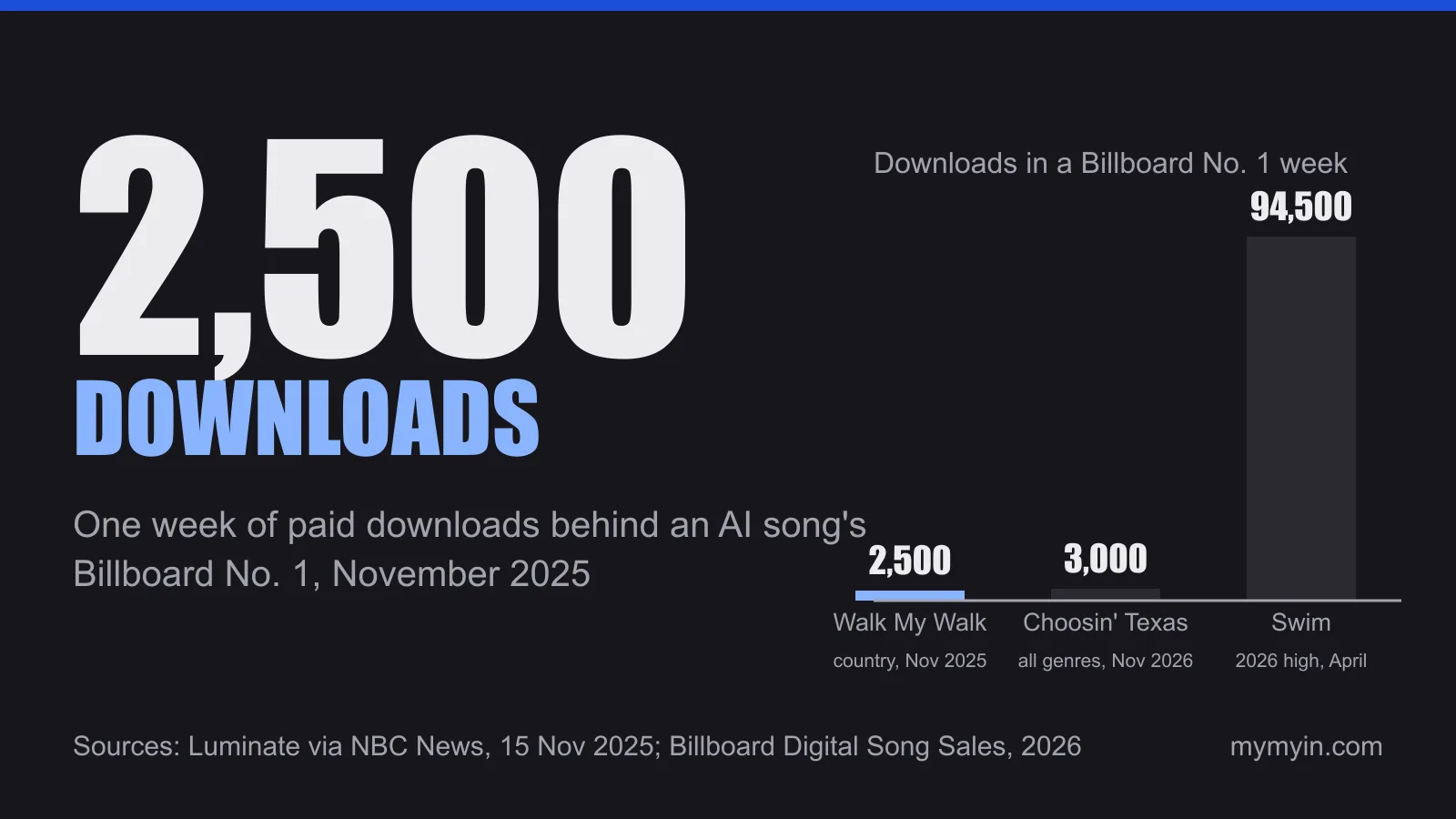
In November 2025 a country song called "Walk My Walk" reached No. 1 on Billboard's Country Digital Song Sales chart on about 2,500 paid downloads, by Luminate figures reported by NBC News. The act credited with it, Breaking Rust, is not a person. NPR and Taste of Country describe a project created with generative AI, prompted by someone credited as Aubierre Rivaldo Taylor; no tool has been named.
The chart position was real. What it means is less clear: which chart, counting what, and made how. To answer that we traced four AI or AI-origin songs that charted in the United States and the United Kingdom between September 2025 and September 2026. We read what each creator, label or detection company has said about the production, and set the chart numbers next to the upload and stream counts that Deezer and Spotify publish. Two facts repeat across the four cases: the fully AI recordings were generated from text, and the American charts they topped count paid downloads, which in 2026 means a few thousand sales.
AI songs on the charts: the four that got furthest
| Song | How it was made, as reported | Best chart result |
|---|---|---|
| "How Was I Supposed to Know?" by Xania Monet, the project of Telisha "Nikki" Jones from Mississippi | Jones writes the lyrics; Suno generates the music and the voice (CBS News, Billboard) | No. 1, R&B Digital Song Sales, chart dated 20 September 2025; No. 30, Adult R&B Airplay, 1 November 2025 |
| "Walk My Walk" by Breaking Rust, credited to Aubierre Rivaldo Taylor, a name also on tracks by the AI project Defbeatsai (Taste of Country, NPR) | Created with generative AI, by NPR's and Taste of Country's accounts; the tool is not disclosed | No. 1, Country Digital Song Sales, November 2025, on roughly 2,500 to 3,000 downloads |
| "Rubberz" by Fenix Flexin, produced by Purps on the Beat, released through Empire Distribution | Generated with Treblo, formerly Sonauto, by Medasin's breakdown and Treblo's classifier; Fenix Flexin confirmed AI use on 7 August 2026 | No. 58, Billboard Hot 100, chart dated 1 August 2026; No. 5, Rhythmic Airplay, 22 August 2026; No. 90, UK Singles Chart, 10 July 2026 |
| "Movin' to the Sun" by Hugel, Imael Angel and Ultra Naté | Angel's first version made in Suno; Hugel rebuilt the track; Naté sang new vocals (Hugel's account, as reported by Pure Glow Radio, October 2026) | No. 2, UK Official Singles Chart, chart week of 28 August to 3 September 2026; No. 1, US Dance Airplay; No. 27, Billboard Global 200 |
These four are the ones we traced; each reached a No. 1, a top five or the Hot 100. They are not the whole field. Xania Monet alone had a second song, "Let Go, Let God", at No. 3 on Hot Gospel Songs in October 2025. Billboard counted at least six AI "artists" in its rankings by 3 November 2025, and NBC News cited Billboard reporting that at least one AI act had debuted in each of the previous six chart weeks.
How "Rubberz" and "Walk My Walk" were made: words, generator, human layer
Three stages repeat across these cases, and the creators describe very different amounts of human work at each one.
The words come first. Jones writes the lyrics herself and uses Suno to turn them into finished recordings, as CBS News reported in November 2025. Imael Angel, in Hugel's account, wrote parts of the lyrics and the melody before generating a first version. For Breaking Rust the writing is credited to Taylor, who is described as having prompted the project, and nobody has said how much of the text was his.
The generator comes next. Suno and Treblo take a short description plus lyrics and return complete recordings, voice included. What matters for the charts is that the output is already a stereo mix, ready for a distributor the moment it renders. Medasin, the producer whose video breakdown came a week before Fenix Flexin confirmed AI use, showed the app producing the "Rubberz" vocal style and its odd phrasing on demand. He also pointed to a pre-release snippet whose file name contained "Sonauto", Treblo's former name (Stereogum, 31 July and 4 August 2026). From there the path is the normal one. Empire Distribution released "Rubberz"; Hugel's label is Make the Girls Dance Records; Jones signed with Hallwood Media in September 2025, in a deal Billboard reported at $3 million after a bidding war.
The third stage is the human layer. Here the four songs part ways. "Walk My Walk" appears to have none beyond the prompt; nobody has claimed a rebuild or a re-recording. For "Rubberz" the question stayed open for two months: Fenix Flexin told Billboard on 11 June 2026 that it was recorded the same as all his music, and then, by Stereogum's account, sidestepped the AI question in interviews. He posted a Pro Tools session as proof and deleted it after Medasin showed how easily AI tracks split into stems. On 7 August 2026 he confirmed the AI use in an Instagram comment, saying he had never denied it, that the AI had nothing to do with the recording process, and that he did not know what the app was until the song was mixed (Stereogum). "Movin' to the Sun" sits at the far end. Hugel says he took Imael Angel's AI version as a starting point and recreated the track himself, that Ultra Naté recorded new vocals, and that pieces of the AI vocal remain in a few places. Four writers share the credit. It is the only one of the four where a known producer and a known singer are credited on the recording that charted. Its chart run also looks like a human record's. It entered the UK chart at No. 85 in the week ending 25 June 2026 and took ten weeks to reach No. 2.
Why AI songs top Billboard sales charts and stall on the Hot 100
Look at which charts the No. 1s came from. Both of the fully AI No. 1s in America were on digital song sales charts for one genre. Those charts count paid downloads in a week, and in 2026 that is a small number. On Billboard's overall Digital Song Sales chart, the No. 1 for the issue dated 7 November 2026, Ella Langley's "Choosin' Texas", sold about 3,000 downloads. Inside one genre the bar is lower, and The Independent noted that at roughly a dollar a track, around $3,000 of purchases would do it. No reporting has shown that anyone did; NBC News wrote on 15 November 2025 that no concrete evidence of inflated numbers had emerged. The year's high point shows the range: BTS's "Swim" sold 94,500 downloads in its No. 1 week in April 2026.
Streaming charts are a different game, because the denominator is everyone. "How Was I Supposed to Know?" reached No. 22 on Digital Song Sales and never entered the Hot 100, Billboard's all-format song chart. Its radio result, No. 30 on Adult R&B Airplay, was the first time an AI song had entered a Billboard airplay chart, according to Billboard. "Rubberz" is the only one of the four to make the Hot 100, and it got there on streams and radio play while its credited artist was still denying or sidestepping the AI question. It peaked at No. 58. As of 3 November 2026, that is the highest Hot 100 position we could find for a song whose credited artist has confirmed it was generated with an AI tool; The Fader called it the first fully AI-generated song to reach the chart.
Until now, "AI song tops Billboard chart" has meant a sales chart, a genre chart, or both, and a few thousand buyers decide those.
What Deezer's numbers say about who is listening
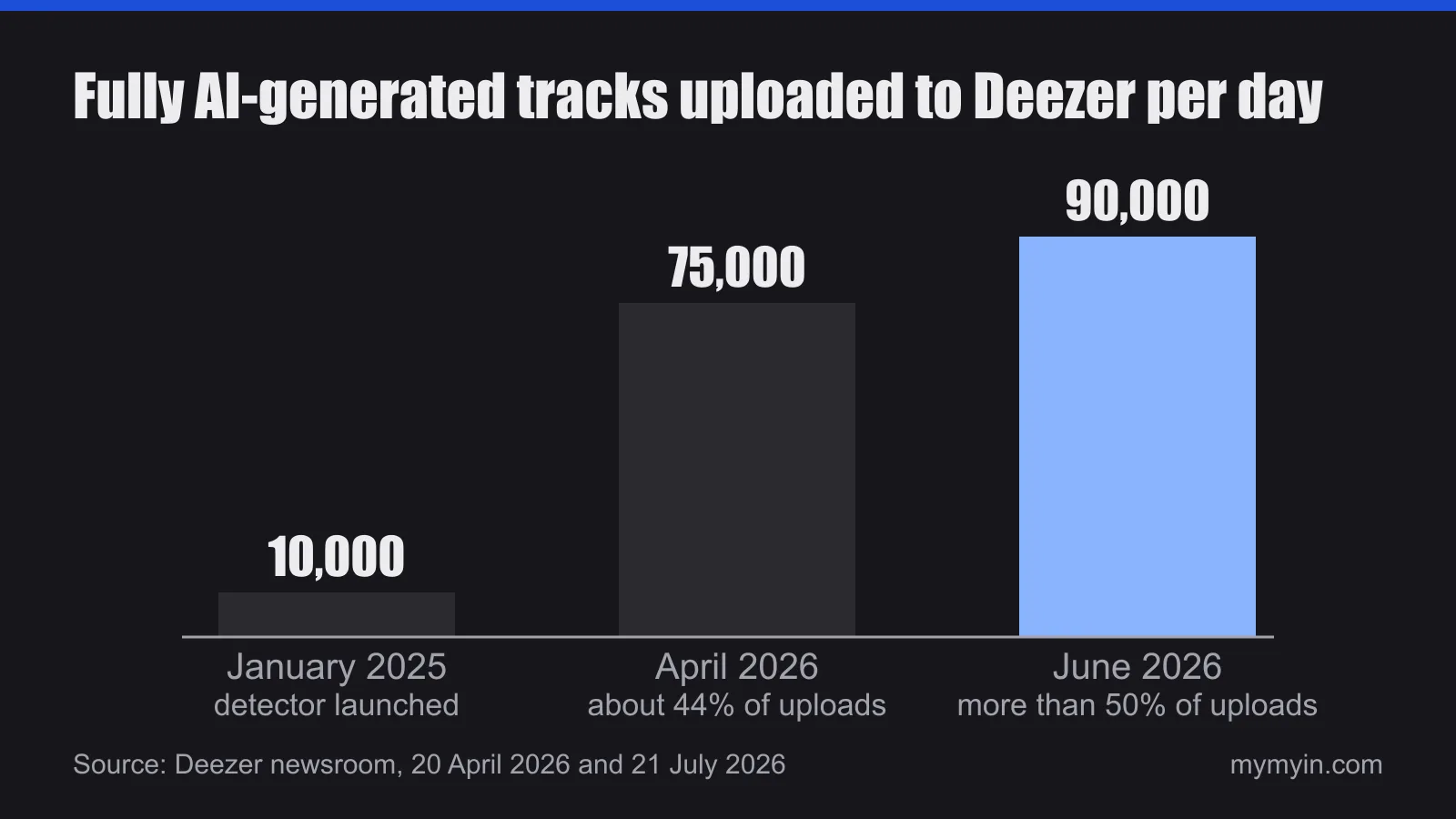
Deezer publishes the only running count of fully AI-generated uploads, and says it is the only platform tagging them. Its detector went live in January 2025 at about 10,000 fully AI tracks a day. By April 2026 the figure was almost 75,000 a day, roughly 44 percent of everything uploaded, and in June 2026 it reached about 90,000 a day, more than half of new uploads on peak days. Deezer tagged 13.4 million AI tracks in 2025 alone.
Listening is another matter. Deezer puts fully AI tracks at 1 to 3 percent of total streams, and says up to 85 percent of the streams those tracks did get in 2025 were fraudulent, against 8 percent across its whole catalogue. Combine the two figures and the share of Deezer streams that are real people choosing a fully AI track comes out between 0.15 and 0.45 percent. That is our arithmetic, not Deezer's; the method and its limits are in the data note at the end.
Spotify's figures point the same way. On 20 October 2026 Spotify said it had taken more than 50 million "slop and spam" tracks out of recommendations during 2026, and had removed more than 75 million spammy tracks from the platform altogether, with no period given. It also said tracks likely to be AI-generated were ten times more likely to fall below its 1,000-stream royalty threshold. Spotify does not count AI uploads the way Deezer does, so the two sets of numbers point the same way but cannot be set side by side.
Listeners cannot tell AI music from human music, and most want it labelled. An Ipsos survey for Deezer in November 2025, covering 9,000 people in eight countries, found that 97 percent could not distinguish the two, 80 percent wanted AI music labelled, and 52 percent said fully AI songs should not sit in the main charts.
The new AI chart rules at IFPI, ARIA, Billboard and the Grammys
Within a year of Xania Monet's No. 1, the organisations that run charts wrote rules. Some label, some exclude.
| Body | Rule | In force |
|---|---|---|
| IFPI, the global record-industry body | Six eligibility criteria, among them an authorised and lawful AI service, a recording that is "substantially human made", no stream or chart manipulation, and AI use signalled to listeners | Announced 30 July 2026. Applied first on the charts IFPI runs in the Middle East and North Africa (13 markets), Southeast Asia (6), South Africa and eight Latin American countries, with more than 20 national charts to follow, including Australia, France, Germany and South Korea |
| ARIA, Australia | Wholly AI-generated recordings are out: an AI lead vocal, an AI main instrument, or a track generated from a prompt. AI-assisted recordings, where humans wrote the song and performed the lead vocal and the main instruments, stay in. Every chart submission now carries an AI declaration, and ARIA can correct published charts and revoke No. 1 awards | Charts dated 31 August 2026 |
| Billboard, United States | No exclusion rule has been published. Billboard has listed the AI acts on its charts, and Deezer says Billboard uses Deezer's detection tool to identify them | 2025 onward |
| Recording Academy, the Grammys | Only human creators are eligible. AI elements are allowed when the human authorship is "meaningful and more than de minimis" | Rulebook since June 2023 |
| Deezer | Detected AI releases are tagged for listeners, kept out of algorithmic recommendations and editorial playlists, demonetised when their streams are fraudulent, and will be removed if nobody plays them for six months | Tagging since 2025; removals announced July 2026 |
ARIA's line would have kept two of these four songs off its chart. Under its definitions, a track generated from a prompt with an AI lead vocal is out. That is what Medasin's breakdown says "Rubberz" is, and what NPR describes for "Walk My Walk". "Movin' to the Sun", with a human lead vocal and a producer's rebuild, reads as AI-assisted under those definitions, though ARIA does not comment on individual tracks and its definition also asks that humans wrote the song, which Hugel's account only partly settles. It has stayed on the chart: it entered the ARIA top 50 at No. 50 on the chart dated 14 September 2026, two weeks after the rule took effect, and had climbed to No. 23 by early November, by the ARIA listings cited on Wikipedia.
How to tell whether a charting song was made with AI
The credits are the first tell. One name doing the writing, producing and performing, attached to a name that also appears on an earlier AI project's tracks, was the Breaking Rust pattern: streaming services list "Walk My Walk" as performed, composed and produced by Aubierre Rivaldo Taylor (The National, 12 November 2025).
Platform tags are the second. Deezer tags the releases its detector catches; the tag sits on the album, not the track. Spotify's AI Credits, launched in April 2026, let artists declare which roles and instruments used AI. Australian chart submissions now carry an ARIA declaration.
Detectors help, with care. When Stereogum ran "Rubberz" through Treblo's own classifier on 4 August 2026, it returned "Very likely Treblo", and AI identification tools used in an AFP report on 12 November 2025 put "Walk My Walk" at 60 to 90 percent likely AI. These tools catch fully generated audio from the big models and miss songs that used AI for one layer.
Timing matters too. Fenix Flexin's "No sir, recorded same as all music I do" was reported by XXL and Billboard on 10 and 11 June 2026; by Stereogum's account he then sidestepped the question in interviews until he confirmed AI use on 7 August. Hugel disclosed the AI origin himself in a radio interview in June 2026 and gave a fuller account in October (Pure Glow Radio, 5 October 2026).
Three of the four began as a text prompt in a generator, by the accounts and detections above, with little human work reported since; the fourth was rebuilt by hand from a generated demo. What put them on the charts was the shape of the charts: paid downloads in the low thousands decide a genre sales chart, and a Hot 100 run can begin before anyone checks the credits. The 2026 rules go after that gap by asking for a declaration before a chart position rather than a detector after it. For more on how chart positions are counted, see our chart and streaming analysis.
About the data
Chart positions come from Billboard chart listings as cited on Wikipedia, checked on 3 November 2026, from the Official Charts Company for the UK and from ARIA for Australia. Download counts come from Luminate as reported by NBC News on 15 November 2025 and from Billboard's Digital Song Sales listings for 2026. Upload and stream figures come from Deezer's press releases of 20 April and 21 July 2026 and from Spotify's newsroom post of 20 October 2026; Deezer publishes point figures rather than a monthly series, so the bar chart shows its three published points. The 0.15 to 0.45 percent figure is our calculation: Deezer's 1 to 3 percent stream share multiplied by the 15 percent of those streams that Deezer did not flag as fraudulent in 2025. It applies a 2025 fraud rate to a 2026 stream share, and because Deezer's 85 percent is a ceiling, the real share could be higher. We did not run any detector on the recordings ourselves. Production details come from the creators' statements and from the reporting in the Sources section; where a creator has not described the process, we say so. How Mymyin checks numbers is described on the About page.
Sources
- NBC News, "A mysterious stranger rode into town and topped a country music chart. He might not be real", 15 November 2025.
- Billboard, 3 November 2025, on "Walk My Walk" and the count of AI acts on its charts; NPR, 10 November 2025; Taste of Country, 7 November 2025; The Independent, 13 November 2025; The National, 12 November 2025.
- AFP report on "Walk My Walk", 12 November 2025, as carried by RTHK and The National.
- CBS News, 5 November 2025, on Telisha Jones; Billboard, 16 September 2025, on the Hallwood Media deal; Billboard, 31 October 2025, on the Adult R&B Airplay entry.
- XXL, 10 June 2026, and Billboard, 11 June 2026, on Fenix Flexin's first reply; Stereogum, 31 July, 4 August and 7 August 2026; The Fader, 10 August 2026; Official Charts Company, singles chart of 10 July 2026.
- Capital Dance, Hugel interview, 17 June 2026; Hugel's account of the production as reported by Pure Glow Radio, 5 October 2026; Official Charts Company listings, June to September 2026; ARIA charts, September to November 2026.
- Deezer newsroom, 20 April 2026 and 21 July 2026, including the Ipsos survey of November 2025.
- Spotify newsroom, "One Year In: Putting Human Artistry First on Spotify", 20 October 2026.
- IFPI, "IFPI rolls out global principles for the eligibility of recordings developed using AI in official music charts worldwide", 30 July 2026.
- ARIA, "ARIA Charts set eligibility rules for recordings made with AI", 25 August 2026, and the ARIA chart changes FAQ.
- Recording Academy AI rules, June 2023, as reported by NPR and Music Business Worldwide.
- Wikipedia, read 3 November 2026: "List of Billboard Digital Song Sales number ones of 2026", "Rubberz", "Breaking Rust", "Xania Monet" and "Movin' to the Sun".
© 2026 Mymyin. All rights reserved. If you quote this article, credit Mymyin and link to the original: https://www.mymyin.com/articles/ai-songs-on-the-charts
More in Charts & Data
Why Are Old Songs Trending? We Counted Spotify's Top 50
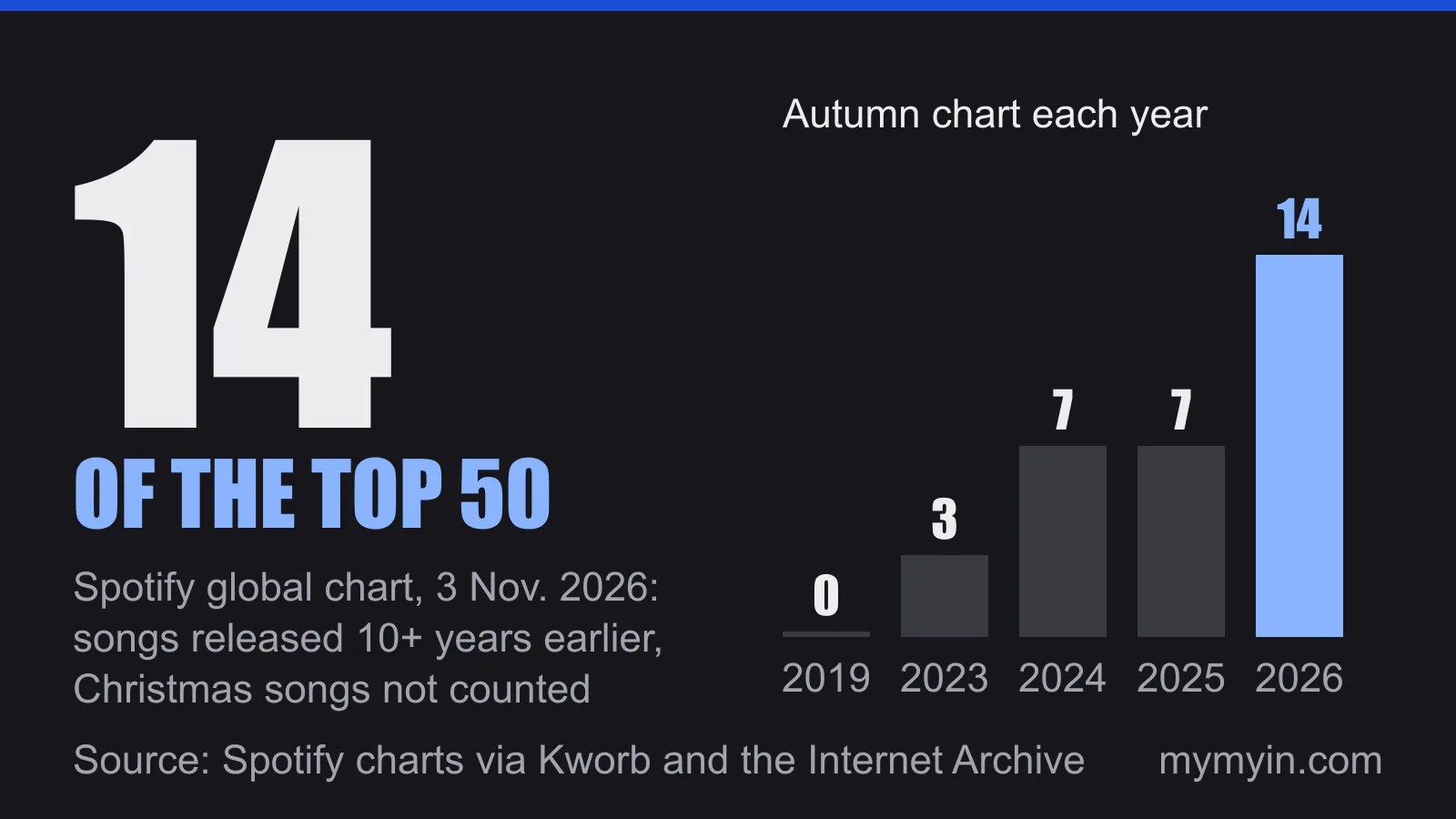
Why are old songs trending? Christmas songs aside, 14 of Spotify's global top 50 on 3 Nov 2026 were 10+ years old; on the autumn 2019 chart, none.
RESCENE "With" Tops Melon in 2 Hours. Can It Chart Globally?
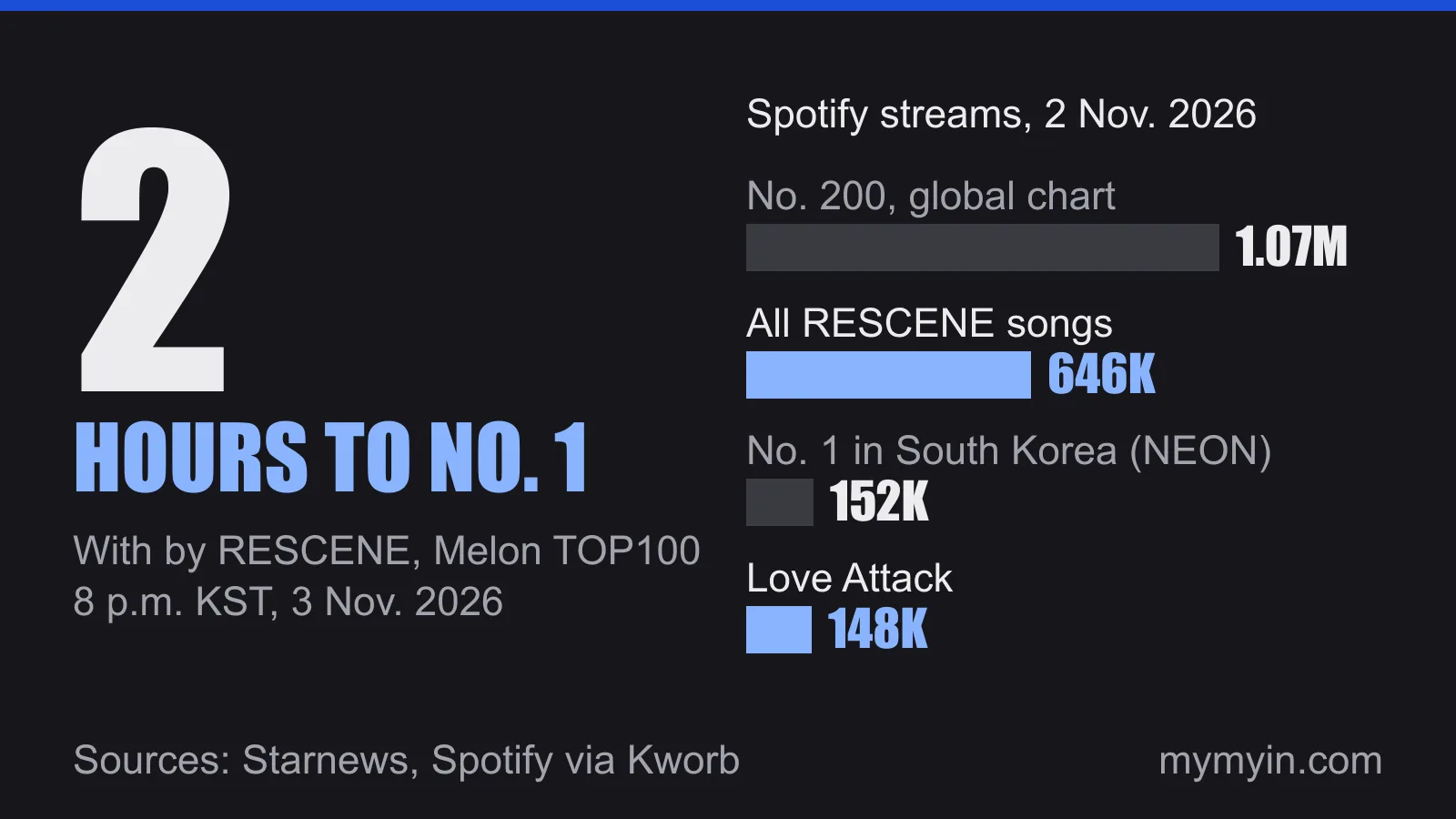
How did RESCENE's "With" top Melon in 2 hours? Half the chart is the last hour. On Spotify, all RESCENE songs draw 60% of the global No. 200's streams.
Longest Running Number One Song on Billboard: Choosin' Texas
What song has held number 1 the longest? Choosin' Texas: 26 weeks at No. 1 on the Hot 100 as of 7 Nov 2026. Our math on when Mariah could win it back.
Comments
No comments yet. Start the conversation.